Introduction
Throughout the fall of 2026, we observed a number of game cheat related binaries in our Assemblyline and CAPEv2 pipeline distributing an advanced Rust loader infection chain that performs Event Tracing for Windows (ETW) patching and indirect syscall resolution to load NWHStealer. The binaries included fake FiveM-External-Cheats, LUA script executors (XenoExecutor, SynapseX), hardware ID spoofers (Silentum Spoofer), and Discord messenger bot (discord-mass-dm-GO.exe) hosted on Gitlab. By pivoting off of the discovered binaries, we were able to find additional Gitlab and Github projects hosting malicious samples masquerading as legitimate executables.
This blog walks through six downloader samples, the Rust loader that we track as WarpLoader and the NWHStealer payload.
Overview
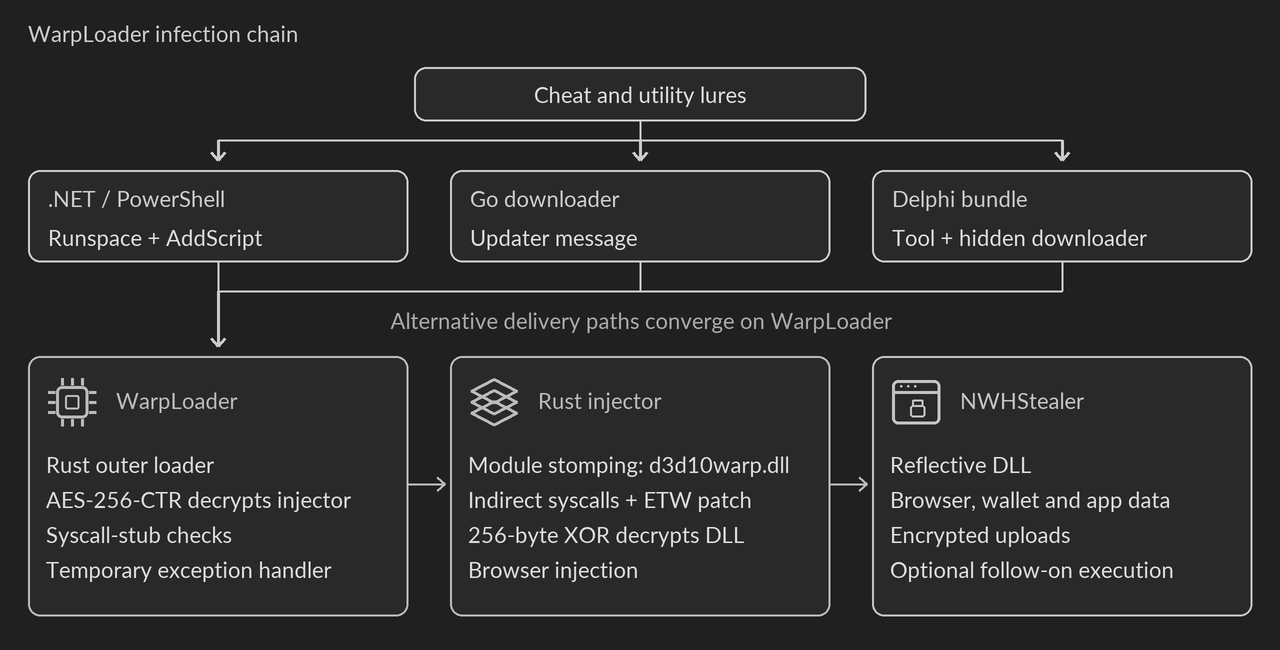
The infection chain is made up of the following components:
Downloader Implementations
.NET Downloaders
Three of the downloader samples contained .NET metadata referencing System.Management.Automation, runspace creation and AddScript used to execute plaintext PowerShell. We refer to these .NET downloaders as ND1, ND2 and ND3 below; full sample hashes are provided in the Appendix.
Two variants use the same hardcoded GitLab URL:

The downloaded payload is written as W52UE52XBY31.exe under a newly generated GUID directory in %LOCALAPPDATA%. Before downloading, the script attempts to exclude that directory from Microsoft Defender scanning with:
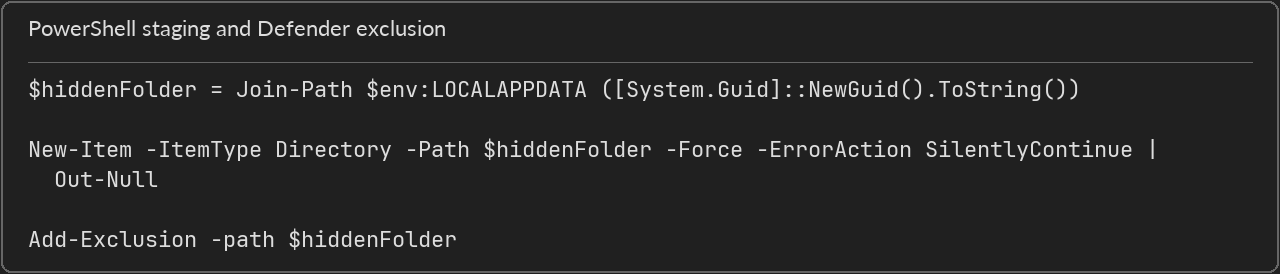
ND1 uses Invoke-WebRequest, while ND2 uses System.Net.WebClient.DownloadFile. Once downloaded, both variants apply the Hidden attribute to the directory and executable, then attempt to start the payload through System.Diagnostics.Process with UseShellExecute = $true, Verb = "runas" and a Hidden window option. This prompts the user to execute within an elevated context through a User Account Control (UAC) dialogue.
ND1 also attempts to register a scheduled task named WindowsUpdateService to execute itself at startup.
A third standalone variant, ND3, uses a Pastebin URL:

That contains the following payload URL:

It then follows a similar directory and defender exclusion, saving the file under %LOCALAPPDATA%\background.exe and attempting persistence under the task name SystemBackgroundUpdate.
Golang Downloaders
Two additional Go downloaders, referred to here as GD1 and GD2, are Windows x64 Go executables built with Go versions 1.24.0 and 1.25.4. In both files, the core functionality is in main.main and two short helper functions, main.a and main.b.
main.main executes PowerShell with a Windows Forms message box displaying Checking for updates..., under the title Updater. The executables then use Pastebin dead drops:
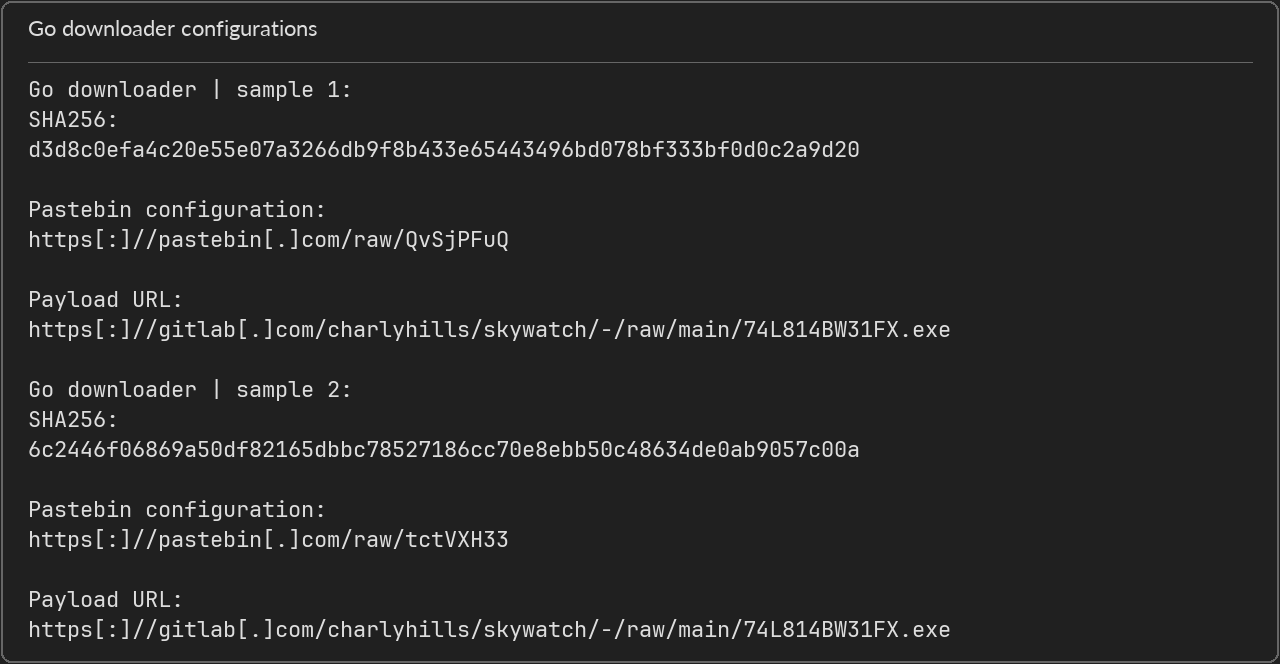
Each file is written to an executable path under %APPDATA%\[a-f0-9]{16}.exe and is started with os/exec.Command([Path]).Start(). The name prefix is generated from eight random bytes encoded as 16 lowercase hexadecimal characters. If random byte generation fails, the downloader uses the default string instead.
A Discord Tool with a Hidden Downloader
The Discord bundle is an 18MB x86 Delphi dropper executable that contains two binaries that are written to %TEMP%\C2Panel.exe and %TEMP%\discord-mass-dm-GO.exe with CreateFileA and WriteFile with the Hidden attribute set. It then launches them with ShellExecuteA.
C2Panel.exe is another .NET PowerShell downloader. It closely resembles the background.exe variant, but adds a Telegram dead drop URL:

Telegram page:
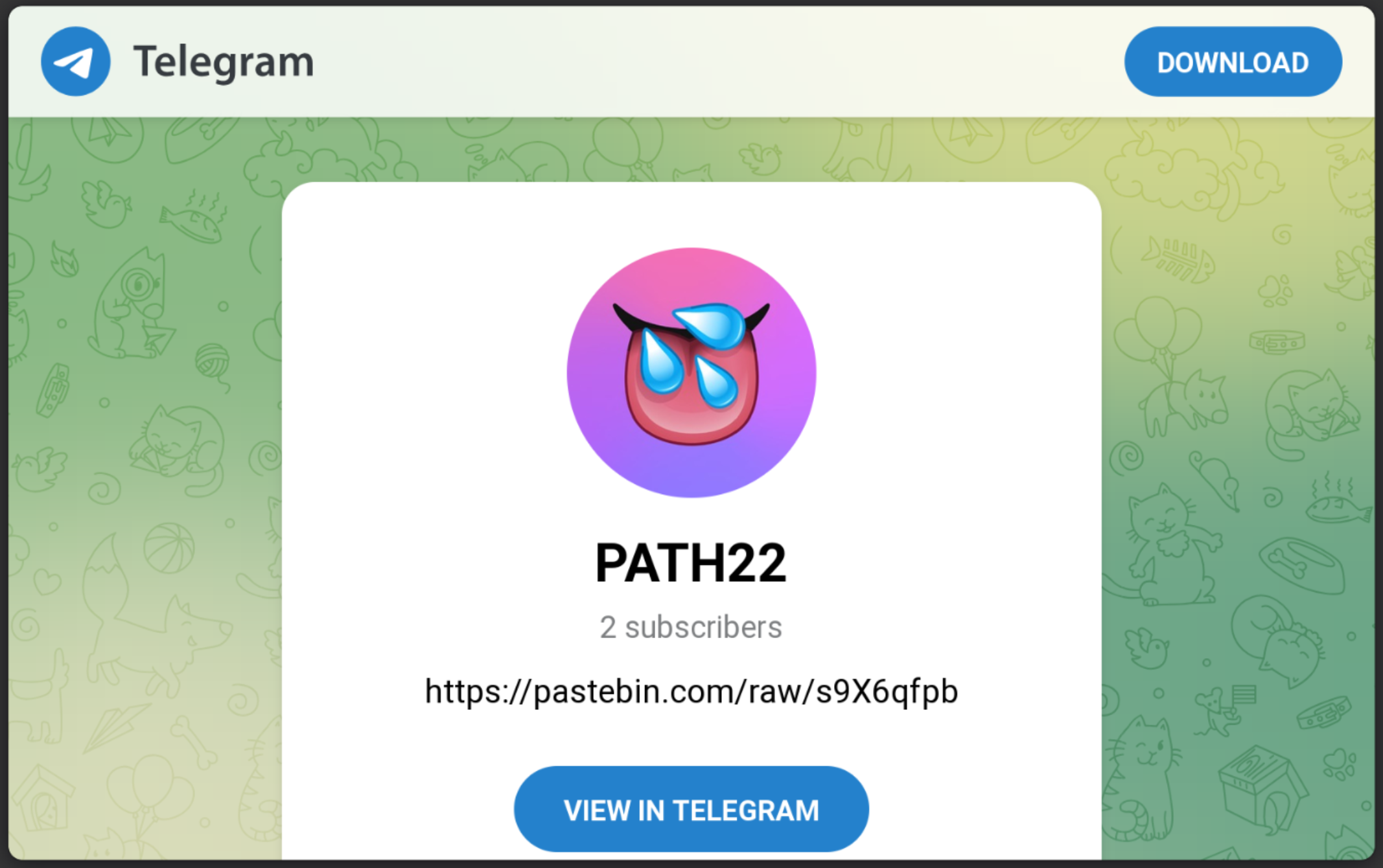
The returned HTML is searched for the first match of the following Pastebin URL pattern:

The script prepends https://, retrieves that Pastebin page, and uses its response as the executable download URL. From there it uses the same GUID-named directory, background.exe filename and SystemBackgroundUpdate for its persistence task name. The Pastebin dead drop leads to the following payload URL:
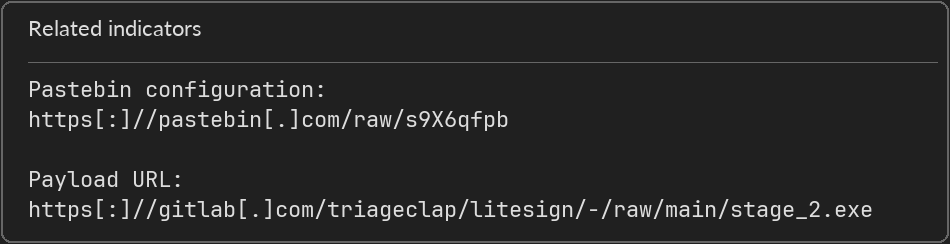
The other embedded file is a copy of the Discord bot discord-mass-DM-Go: https://github.com/V4NSH4J/discord-mass-DM-GO.
Distribution Sources
Pivoting off of the downloader samples through urlscan (shout out Jojo), repository searches and public sandbox runs resulted in a number of additional lure hosting locations and fake lure names:
- GitLab - FiveM mod cheats:
millycage/fivem-mod-menuhosted ND3 asLoader.exe, andRachelBenz/skriptggandgoldenchart/fivem-mod-menuhosted GD1 asLoader.exe. Another SkriptGG-named project,Lunizmarshall/skriptgg, hosted the same Go downloader asSkriptGG.exe. - GitLab - Valorant and Fortnite cheats:
TwistShop/valorantexternalcheathosted GD1 asLoader.exe. The same sample appeared infortnitetools/fortnite-ragdoll-v2-privcheat-including-softaim-esp-wallhack-triggerbot-and-more-18567, whose project name advertised a Fortnite cheat with soft aim, ESP, wallhack and triggerbot features. - GitHub - FiveM external cheat:
hammeis/FiveM-External-Cheathosted a root-levelLoader.exematching theC2Panel.exedownloader extracted from the Discord bundle, not the complete bundle. This connects the same downloader to both a Discord-tool bundle and a FiveM-cheat repository. - Sandbox run archives - Fluxus and Solara:
FluxusExecutor.zipcontained ND3 asFluxusExecutor/Fluxus V7.exe;SolaraExecutor.zipcontained GD1 asSolaraExecutor/Solara V3.exe. These names presented the downloaders as Lua script executors. Sandbox reports establish the matching files inside the archives, but not their original download sites. - FiveM mod archive - QuantV -
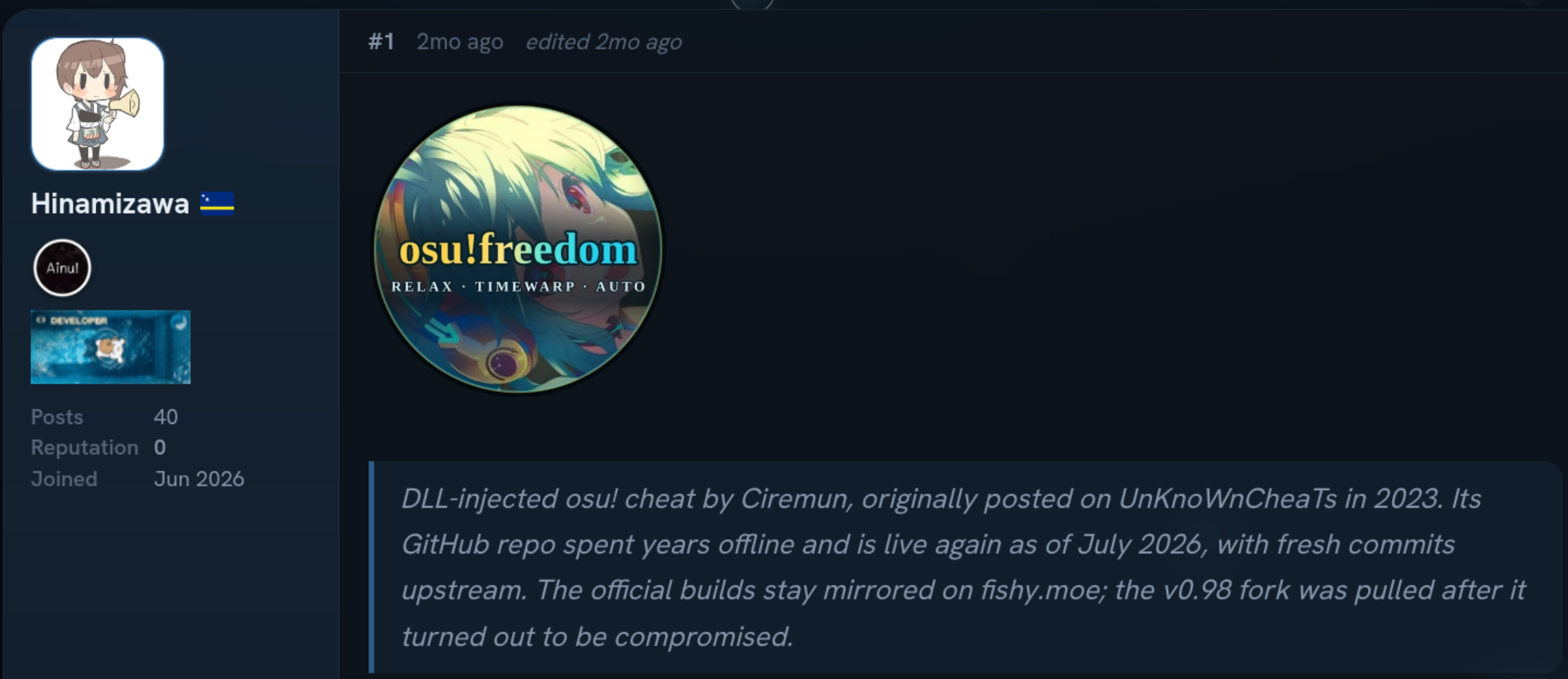
QuantV FiveM August 2026.zipcontained GD1 under three installer/uninstaller paths:_Install/FiveM/QV3_Install_FiveM.exe,_Install/SinglePlayer/QuantV_Install.exeand_Uninstall/QuantV_Uninstall.exe. These paths presented the downloader as installation and removal components for a game graphics mod. The original download site is unknown. - Community Freedom Mirror - A fishy.moe forum post reports that the site previously mirrored a compromised Freedom v0.98 fork. Its reported
freedom.exehash matches GD2; the author says the file was subsequently removed on August 26, 2026:
Recovering the Rust Injector
The WarpLoader sample analyzed in detail is ee224045a89b4bb62af10c017ec15fe966b72fc23de2f6fa13b79cf232a31958. This loader contains the source crate path of crates\stub\src\resolve.rs (likely related to syscall resolution, more on this later). The main loader function begins by decrypting an embedded PE with AES-256-CTR with the key ec42e37baa9e5de642d8bf0a66a4e3142120c06dd7b78c6fbc60e7285e9023af and Initialization Vector (IV) 6a08686b19a2ab040000000000000000. The result is a complete unmapped PE file with the SHA256 2dd8fd009987a2e78a28c830cf37add474f162a9ead7583dbf93d4ab4b0f25fb.
Module Stomping
The sample uses module stomping to write this unpacked PE to a legitimate Microsoft Windows DLL that is dynamically loaded at runtime.
Dynamic Function Resolution and Syscall Stub Anti-Analysis
The module stomper performs dynamic API resolution and syscall fingerprinting before it reflectively injects a decrypted DLL into a target browser(s). This is a part of the main routine at 0x140002492, with export resolution at 0x140004BDB and a syscall fingerprinting function at 0x140004E49.
The loader walks the InLoadOrderModuleList to locate ntdll.dll and kernel32.dll, then parses their export tables and hashes all export function names with the DJB2 algorithm to find the following functions:
| Native API | DJB2 hash |
|---|---|
NtProtectVirtualMemory |
0x082962C8 |
NtFlushInstructionCache |
0x80183ADF |
NtQuerySystemInformation |
0xEE4F73A8 |
NtFreeVirtualMemory |
0x471AA7E9 |
NtTraceControl |
0x7EB77B17 |
The syscall fingerprinting checks for bytes 4C 8B D1 B8, corresponding to mov r10, rcx followed by mov eax. The main routine separately scans executable sections of ntdll for 0F 05 C3, or syscall; ret. These byte sequences are expected to occur within unhooked NTDLL functions. If Endpoint Detection and Response (EDR), user mode sandboxes or antivirus alter these original syscall stub bytes to create a detour/trampoline, then the fingerprinting function returns 0 and the process exits with ExitProcess.
Hardware Breakpoint and Vectored Exception Handler Anti-Tracing
The module stomper also resolves RtlAddVectoredExceptionHandler and RtlRemoveVectoredExceptionHandler. It registers the handler at 0x140004AA1 with first handler priority, stores the resolved address of NtTraceControl, sets an initialization flag and executes INT 3. This generated exception allows the handler to configure a hardware breakpoint by setting up a thread context.
The handler processes two types of exceptions:
| Exception | Handler functionality |
|---|---|
EXCEPTION_BREAKPOINT (0x80000003) |
When the initialization flag is set, it writes the NtTraceControl address into the saved Dr0 register, enables the execution breakpoint through the Dr7 register, advances the saved RIP and clears the initialization flag. |
EXCEPTION_SINGLE_STEP (0x80000004) |
When the exception address matches NtTraceControl, the Dr6 register is cleared, and the saved instruction pointer is advanced |
For the handled cases, it returns EXCEPTION_CONTINUE_EXECUTION to continue execution. When the hardware breakpoint hits at the NtTraceControl address, the saved RIP is advanced by three bytes if the first byte is 0x4C, otherwise it is advanced by one byte. Looking at the NtTraceControl syscall stub, the three-byte adjustment skips its opening mov r10, rcx. This alters the register setup for the subsequent syscall, which bypasses ETW tracing throughout the loader’s execution.
Using a hardware breakpoint also avoids patching the target function’s instructions, which is likely watched by security technologies.
Mapping the Decrypted Image
After decryption, the loader dynamically resolves C:\Windows\System32\d3d10warp.dll with LoadLibraryExW. The call uses DONT_RESOLVE_DLL_REFERENCES, which maps the DLL without performing its usual import resolution and initialization.
The loader then parses the mapped DLL’s PE headers and walks its section table. It looks for an executable section whose virtual size is large enough to contain the decrypted program’s complete image.
Once a suitable section is found, the loader changes its protection to writable and clears it and the DLL being injected is written to it.
The start of the overwritten section is used as the new image base. Each embedded section is copied to that base plus its original Relative Virtual Address (RVA), after which the loader processes relocations and resolves imports. The code also performs Thread Local Storage (TLS) setup, applies section protections and flushes the instruction cache before transferring execution to the newly written code’s entry point.
Browser Injector and Indirect Syscall Resolution
The stomped module code is a Rust DLL injector that contains the source path of injector\src\injector\syscalls.rs and contains functionality for syscall resolution for memory operations and browser injection. All strings used throughout its execution are decrypted with a rotating XOR cipher and the key xnasff3wcedj. This recovers syscall names, browser arguments and the reflective-loader export name.
It enumerates ntdll exports beginning with Zw, sorts their addresses and uses their position in that ordering to populate a syscall table. It also searches the opening bytes of each candidate for 0F 05 C3, or syscall; ret, and stores the instruction address in a corresponding table entry.
The dispatcher at 0x1400185F0 takes a table entry followed by the native-call arguments. It moves the first argument into R10, rearranges the remaining register and stack arguments, loads the service number into EAX and calls the stored instruction address. The relevant instructions are:
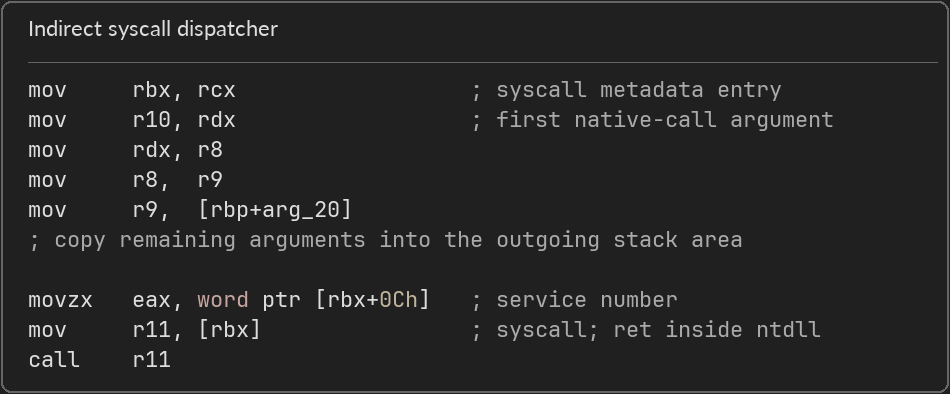
These are therefore indirect syscalls since the injector prepares the call, but the transition to the kernel executes from a syscall instruction inside ntdll.dll.
The following call sites are where the syscall table is used:
| Call site | Native operation | Purpose |
|---|---|---|
0x140002F94 |
ZwProtectVirtualMemory |
Make the three-byte EtwEventWrite region writable |
0x140002FC9 |
ZwProtectVirtualMemory |
Restore protection after patching |
0x140004248 |
ZwAllocateVirtualMemory |
Allocate payload memory in the browser process |
0x140004286 |
ZwWriteVirtualMemory |
Write the decrypted DLL into that process |
0x1400042DD |
ZwCreateThreadEx |
Start a remote thread at the reflective-loader entry |
0x1400042F8 |
ZwClose |
Close the created thread handle |
0x140004315 |
ZwResumeThread |
Resume the browser thread |
The injector also resolves EtwEventWrite, changes its memory protection and replaces its first three bytes with:

This is another technique used to bypass ETW, which is peculiar as this method is much more invasive than the hardware breakpoint technique observed in the loader.
The injector decrypts a final NWHStealer payload using the decryption loop:
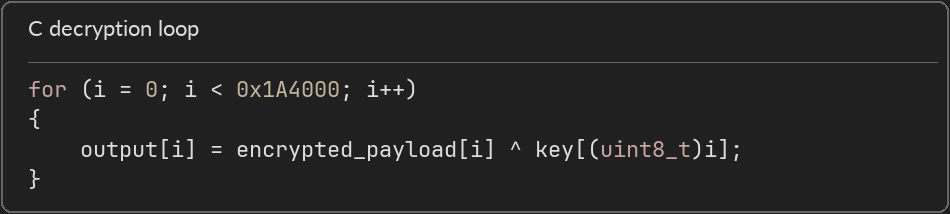
This results in a DLL with the SHA256 1ce31bbe51328ee1bc759cbe34aa964ceeb370971d20ecb470dd371265d0fcf3. The loader then enumerates processes for browsers to inject the DLL into, including Chrome, Edge, Brave, Chromium, Opera, Opera GX and Vivaldi, which the DLL is reflectively injected into using the indirect syscalls described above.
From Reflective Loader to Credential Collection
The decrypted DLL contains the export KdMXFBaWQ, which contains its reflective loader functionality 0x18012D070. That function resolves the APIs it needs, allocates and maps the image, processes imports and relocations, initializes TLS, and calls the mapped DLL entry point. DllMain at 0x180003002 disables thread notifications and starts the main NWHStealer functionality at 0x18001F751.
The malware identifies its browser context, selects the corresponding user data location, obtains browser encryption keys and walks profile directories. Chrome, Edge and Brave receive browser-specific handling, while other branches select locations for Opera, Opera GX, and Chromium.
There is also stealer functionality covering Firefox, wallets and desktop applications.
Reading Chromium Databases
The Chromium stealer functionality uses a compiled SQLite Rust crate rather than invoking a separate database utility. The login stealer functionality at 0x1800343AB uses the query:

For each row, it retrieves the origin and username, obtains the password as a blob, and passes the protected value to the decryption function at 0x180027EF3.
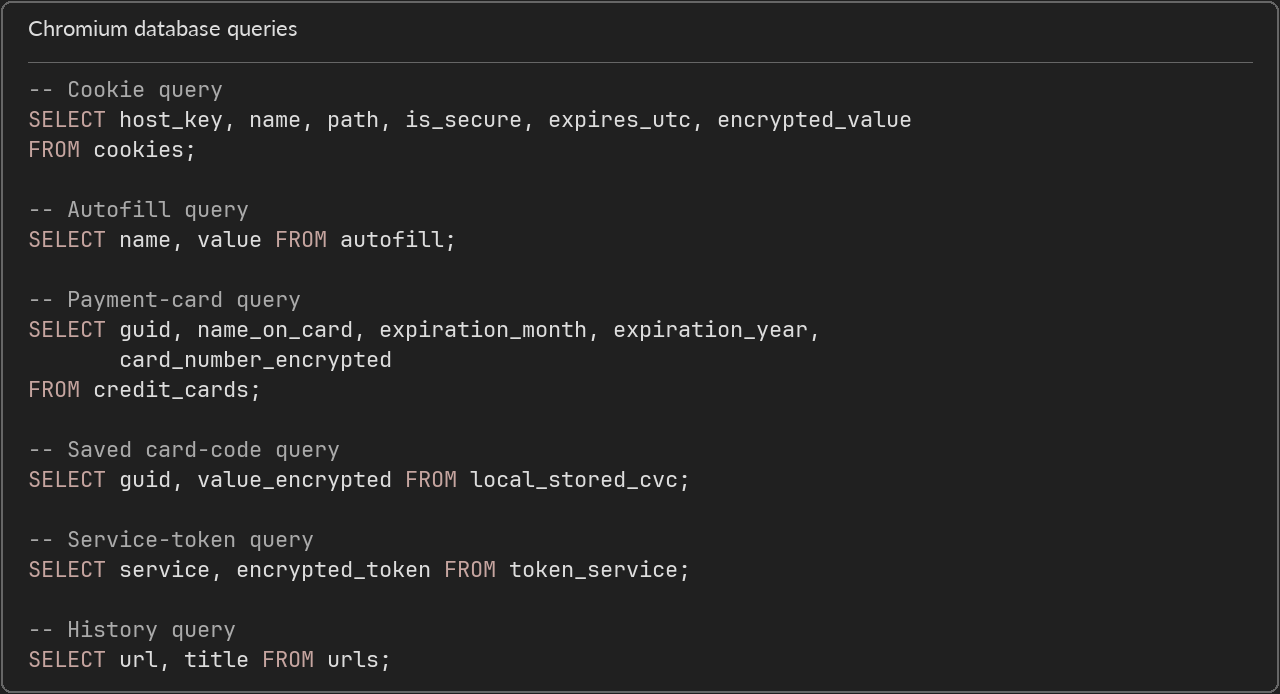
The surrounding browser stealer code also queries cookies, autofill, payment-card data, service tokens and browsing history using the following queries:
Recovering Browser Encryption Keys
The encrypted fields require a key for decryption, and the malware contains specific functionality for older Chromium-protected values and newer app-bound formats.
The routine at 0x180028721 reads the browser’s Local State data, locates encrypted_key, Base64-decodes it and removes the leading five-byte wrapper before passing the remaining bytes to Windows data-protection code. The DPAPI wrapper dynamically loads crypt32.dll and resolves CryptUnprotectData. Successfully recovered keys are stored by the source path, avoiding the need to repeat the operation for every database value.
A separate routine at 0x180028120 searches for app_bound_encrypted_key. It Base64-decodes that value, skips its four-byte prefix and selects browser-specific Component Object Model (COM) class and interfaces for Chrome, Edge or Brave. These identify the browsers’ Elevation Service objects and their IElevator-family interfaces, which expose a DecryptData method. Reconstructing the GUIDs from the constants in the routine produces:
| Browser | Elevation Service CLSID | Browser-specific interface IID |
|---|---|---|
| Chrome | 708860E0-F641-4611-8895-7D867DD3675B |
463ABECF-410D-407F-8AF5-0DF35A005CC8 (IElevatorChrome) |
| Edge | 1FCBE96C-1697-43AF-9140-2897C7C69767 |
C9C2B807-7731-4F34-81B7-44FF7779522B (Edge’s extended elevator interface) |
| Brave | 576B31AF-6369-4B6B-8560-E4B203A97A8B |
F396861E-0C8E-4C71-8256-2FAE6D759CE9 (Brave’s elevator interface) |
The routine tries two interface identifiers for each browser. Before the browser-specific IIDs above, the Chrome branch attempts 1BF5208B-295F-4992-B5F4-3A9BB6494838, which Chromium identifies as IElevator2Chrome, while the Edge branch attempts 8F7B6792-784D-4047-845D-1782EFBEF205, used for its IElevator2 variant. The Brave branch also attempts the Chrome IElevator2Chrome IID before falling back to its Brave-specific identifier.
After initializing COM, the routine calls CoCreateInstance with CLSCTX_LOCAL_SERVER and configures the returned proxy using CoSetProxyBlanket. The subsequent virtual call resolves to the Elevation Service’s DecryptData method, whose declared signature is:

The method decrypts the supplied app-bound key material and returns the result through the plaintext argument. The relevant vtable entries and their offsets are:
| Method | Chrome / Brave entry | Edge entry |
|---|---|---|
IUnknown::QueryInterface |
0 | 0 |
IUnknown::AddRef |
1 | 1 |
IUnknown::Release |
2 | 2 |
RunRecoveryCRXElevated |
3 | 6 |
EncryptData |
4 | 7 |
DecryptData |
5 | 8 |
These layouts can be compared with Chromium’s official elevation-service IDL and public research documenting the Edge interfaces.
The recovered key is then used to decrypt collected browser entries.
Firefox and Gecko-Based Browsers
The stealer contains a typical implementation for Firefox data. It searches Firefox profile locations and reads logins.json, including the hostname, encryptedUsername and encryptedPassword fields. It then loads the browser’s NSS library and resolves:
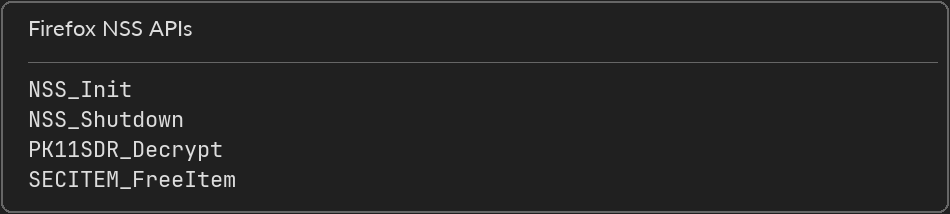
The Firefox NSS functions are then used to decrypt saved credentials. The stealer also queries Firefox’s SQLite databases for cookies, history and form data, including moz_formhistory and moz_places.
Wallets and Browser Extensions
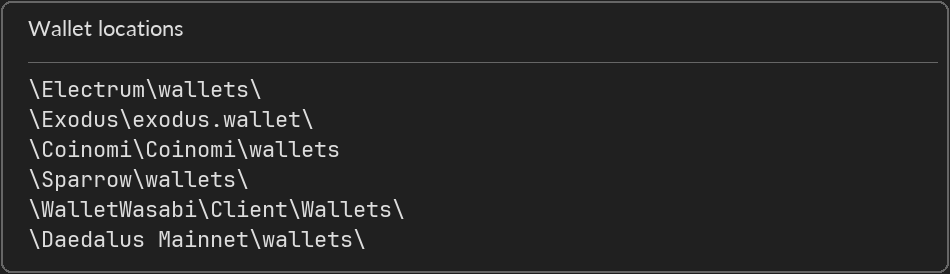
The malware collects cryptocurrency wallet information from desktop applications and browser extensions. The desktop application functionality at 0x18002F890 includes targets such as Electrum, Exodus, Coinomi, Sparrow, Wasabi and Daedalus at paths:
The extension catalog at 0x1800358FD is considerably larger. It constructs 201 identifier/name pairs, including cryptocurrency wallets and password managers such as Bitwarden, LastPass, 1Password, Dashlane and Proton Pass. A complete list of extensions is provided in the Appendix.
Discord, Telegram and Other Applications
The Discord stealer at 0x18002EB47 scans LevelDB .ldb and .log files for several token patterns. It includes expressions for conventional dotted tokens, multifactor tokens and protected records beginning with:

Telegram functionality targets tdata and related client storage. Other applications the stealer functionality references are Steam configuration and authentication-related files, Roblox cookie storage, VPN profiles, and FTP or messaging-client credentials.
AI and Developer-Tool Data
One of the more notable targets begins at 0x180150228. It contains 13 path/label pairs for AI assistants and development tools:
| Application label | Relative target path |
|---|---|
| Claude Code | .claude\.credentials.json and .config\claude-code\credentials.json |
| Codex CLI | .codex\auth.json and .config\codex\auth.json |
| GitHub Copilot | .copilot\config.json, .config\github-copilot\hosts.json and .config\github-copilot\apps.json |
| Cursor | AppData\Roaming\Cursor\User\globalStorage\state.vscdb and storage.json |
| Continue | .continue\config.json |
| Codeium | .codeium\config.json |
| JetBrains AI | AppData\Roaming\JetBrains\*\options\ai.assistant.xml |
| Tabby | .tabby-client\agent\config.toml |
Screenshots and Host Information
The stealer also has information collection and screenshot capabilities. Its screenshot functionality uses GDI calls including CreateCompatibleDC, CreateCompatibleBitmap, StretchBlt and GetDIBits to obtain a screenshot.
The information collection logic calls GetUserNameW and GetComputerNameExW, obtains Windows version information, registry values for MachineGuid, processor name, display-driver description and locale.
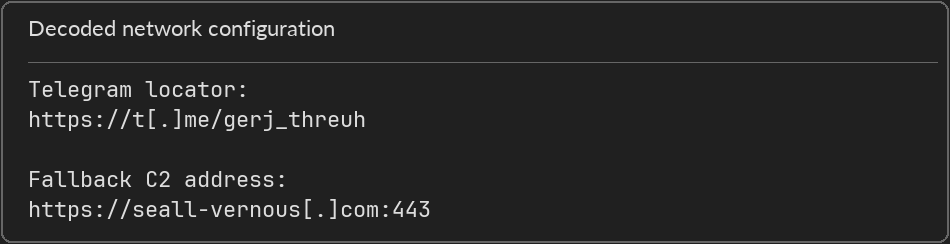
Decoding the Network Configuration
The payload’s string obfuscation is separate from both the outer AES layer and the injector’s XOR layer. The decoder at 0x180052420 checks the environment variable CRYPTIFY_KEY and otherwise uses the 12-byte fallback key:

The key is repeated over the encoded string. Applying that decoder to the configuration values recovers:
Telegram Dead Drop Resolver
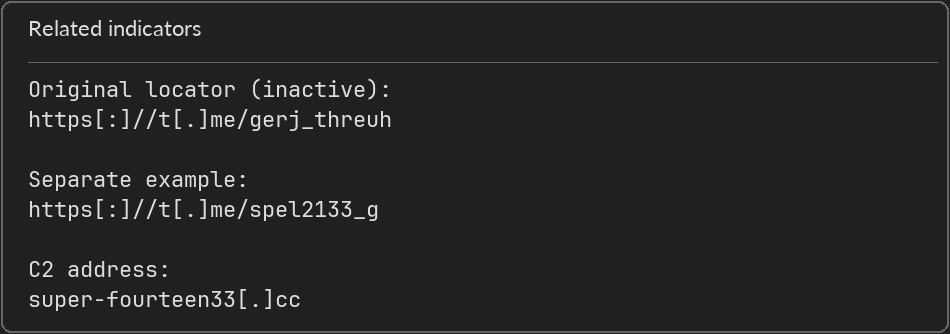
The destination resolver at 0x18003C945 requests the Telegram page through WinHTTP and searches the returned HTML for:

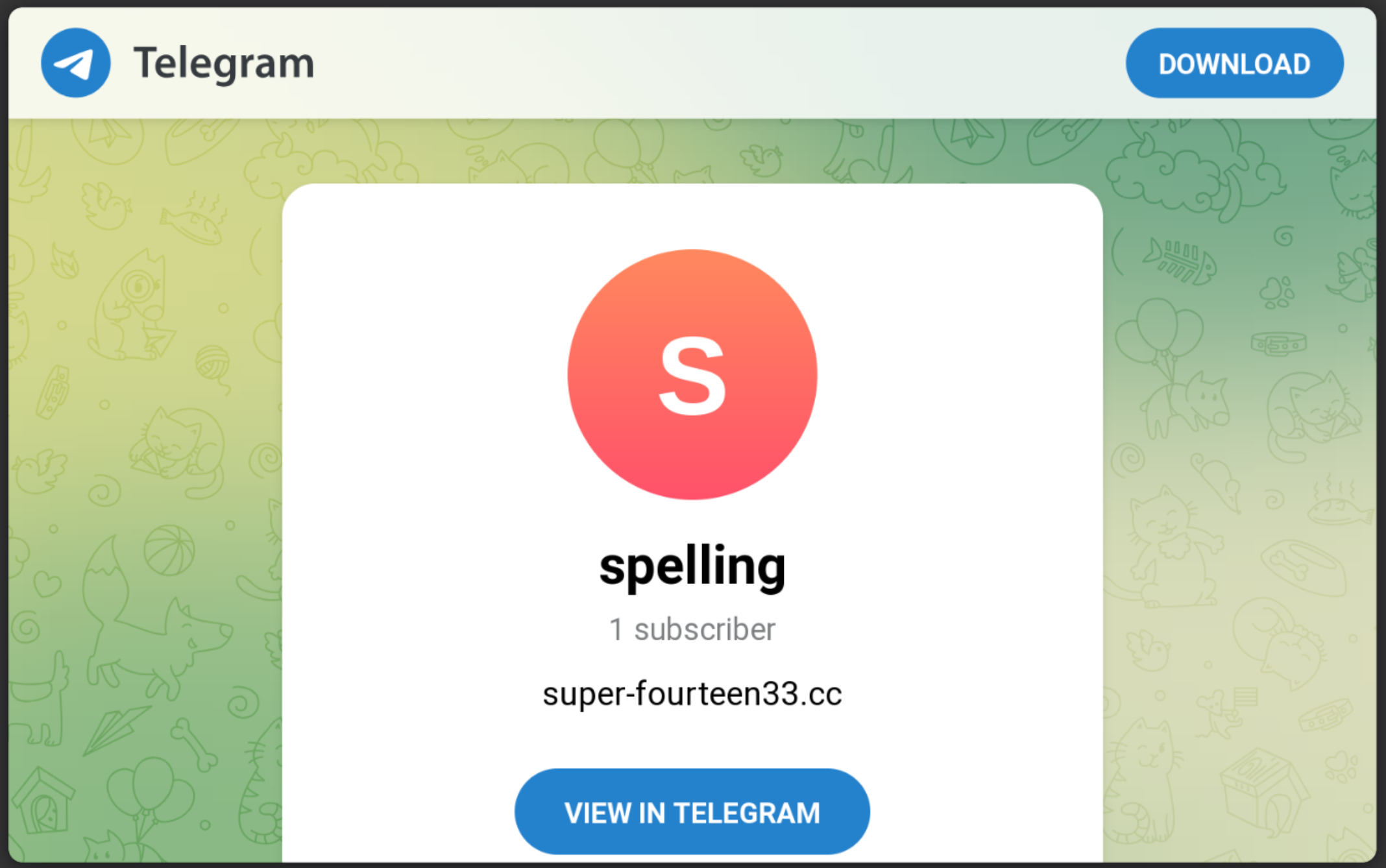
The Telegram dead drop was not active at the time of analysis, however, a separate Telegram example contained the C2 address, as shown below:
Queuing and Uploading Collected Records
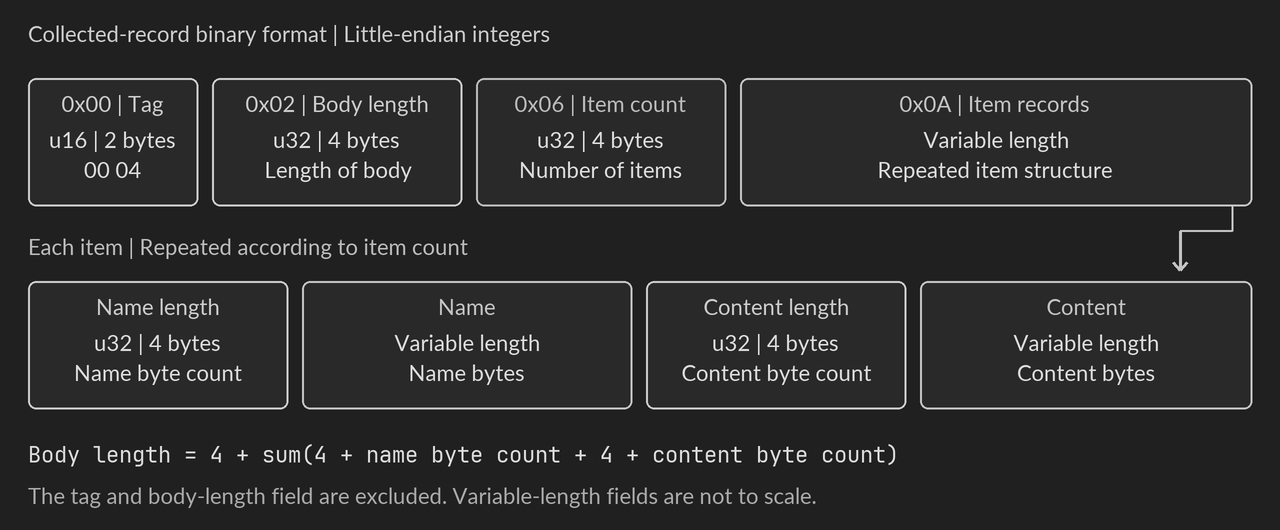
The functionality at 0x180024CAC packages the collected records into a custom binary format. It first writes the item count, then iterates over the records, writing each name and its contents with their respective lengths. The resulting body is prefixed with a two-byte tag, 0x0400, and a four-byte body length. All integer fields are little-endian format:
The encryption and upload routine at 0x18003D42E first resolves the C2 URL, then prepares the collected data for transmission. The transport secret is stored as 32 XOR-encoded bytes at 0x180154380. The string decoder at 0x180052420 uses the same XOR key used to decrypt the network configuration to decrypt the secret:

A transport key is derived by hashing the secret with SHA256. The routine generates a separate 16-byte IV for each upload and encrypts the serialized packet using AES-256-CBC with PKCS#7 padding. The request includes a 12-byte hash-derived marker, the IV and the ciphertext, but not the key.
The complete HTTP request body has the following layout:
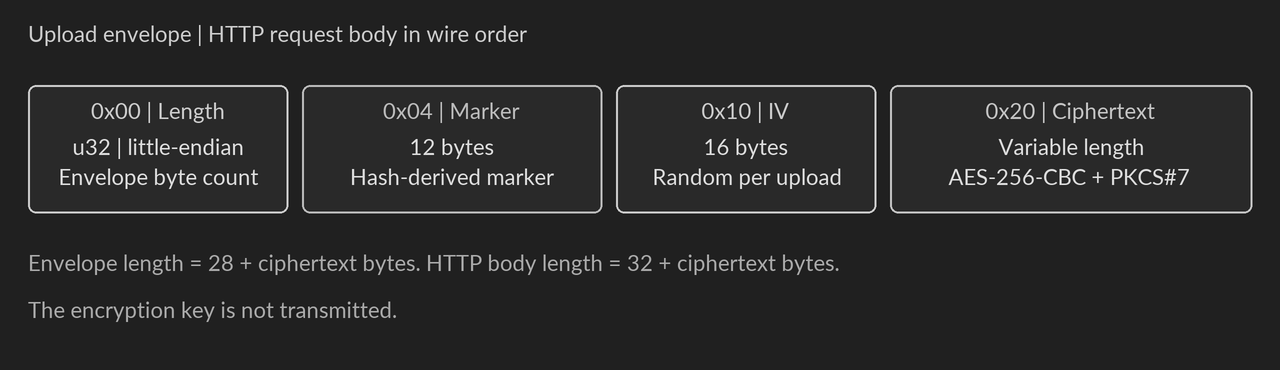
The HTTP helper at 0x18003B49D uses WinHttpOpen, WinHttpConnect, WinHttpOpenRequest and WinHttpSendRequest, placing the encrypted bytes directly in the request body. WinHttpOpen is passed a null user-agent argument, so there is no custom user-agent string supplied at that call.
Download and Execution Functionality
The malware also contains download and execution functionality separate from the stealer functionality. This includes decoding a different 32-byte configuration value and encrypts the command getPayload before sending a request to the C2 URL
Payloads are downloaded to the following %LOCALAPPDATA% directories:
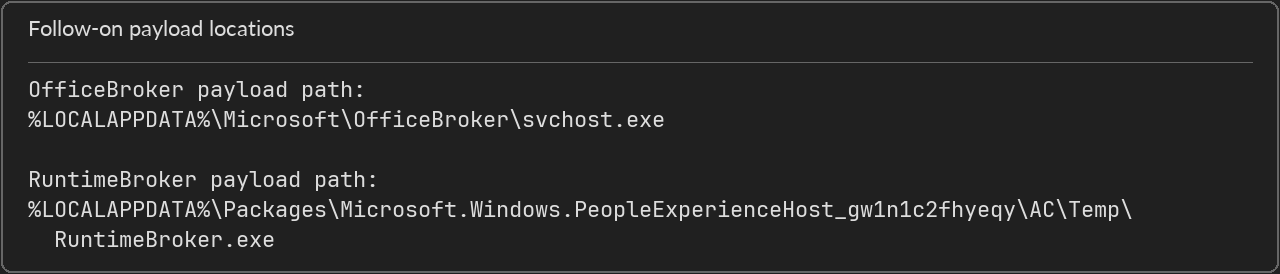
The payloads are then executed with CreateProcessW, passing CREATE_NO_WINDOW (0x08000000) in the dwCreationFlags argument.
Conclusion
Cheat and utility lures are used to deliver NWHStealer through several downloader implementations and the Rust loader that we track as WarpLoader. Unpacking the infection chain reveals encrypted stages, module stomping, ETW tampering and indirect syscalls used to load the stealer into browser processes to perform sensitive information collection and execute additional payloads.
The downloaders are of below average sophistication compared to their follow-on payloads, and present a number of detection opportunities through use of command-line PowerShell tools. Their follow-on payloads, however, demonstrate a concrete understanding of Microsoft Windows internals, common AV and EDR bypass techniques and modern stealer functionality. The delivery tools, techniques and procedures (TTPs) align with targeting of individuals, rather than organizations, due to their profile fitting game enthusiasts rather than enterprise users. The stealer does, however, present risks to shared Bring Your Own Device (BYOD) environments and shared devices that are also used for gaming. This assessment is made with high confidence based on lure names observed within our analysis pipeline and external services.
IOCs, Detection Rules and Appendix
All Indicators of Compromise (IOCs), detection rules and the Appendix containing all targeted stealer information in full can be found on our community Github repository.